
A Healthy Mix
Previously, I said the way to become more productive is to focus more on the quality and value of what you do than on the quantity. It’s not how much you do, it’s how much what you do matters.
That sounds great (at least it does to me), but how do you choose? Out of everything on your to-do list, what has the most value? What makes the most difference?
I have a recipe for that I can fall back on when I find myself at junction of a myriad of possible workflows to step into. The recipe calls for a healthy mix of different types of work, like a balanced meal. It mixes four ingredients, in equal measures. Let me explain.
The Recipe
The ingredients are 4 different types of task/activity. I call them: goalpost movers, enjoying life, necessary maintenance, and recharging time.
Goalpost Movers
Life is not a static situation, but a journey into the future. You determine that journey by the choices you make, over and over again. If you are clear about your goals and ambitions, as I try to be, you want to see progress in the right direction. You want so yourself moving closer to your destination.
For this reason, when plan my work-week, I look first for things that I can do this week that are most in line with the future I envision for myself. I keep this work at the top of my list, and pick 3 of them as targets for the week. I call these the goalpost moving tasks. Per day I reserve time for these tasks, but not so much they take up all of the day. The goal is to have them done by the end of the week. Not to rush through them at the expense of everything else.
Enjoying Life
But life is not just about achieving goals. Life is also about experiencing life itself. The journey, and especially the full appreciation of it, may be even more important than the destination it leads to.
Every day I make sure to at least 3 experience-related task or activity. These are very personal choices, so you will have to find your own. For me, they are things like taking a stroll across our forest property, playing a bit of piano, talking to my wife, reading a book, … Anything that feels good and is active but not too demanding. It’s these activities that help me look back at most days, knowing that they have been good days. Spread out over the month, I also include a few “mini vacations”: concerts, shows, day-trips and other non-work outings my wife and I enjoy immensely.
Necessary Maintenance
Not everything I do is ambitious or enjoyable. Another necessary pick for the week is the kind of work that comes with my responsibilities as a husband, father, home owner, citizen, and human being. Some physical exercise, cooking dinner, making coffee, small repairs, mowing the lawn, doing my tax returns, talking to the neighbours, being active in the community, … The list goes on.
I sprinkle my days with a few small ones, like making coffee and cooking dinner. The bigger ones I try to spread out across the week, or month, depending on how much time and effort they take. I try, as much as possible, to approach them as enjoying life tasks, so they don’t feel too much like work. When that doesn’t work (I just can’t get myself to enjoy tax returns, for instance), I overcome my resistance by accepting them as necessary maintenance – not always pleasant, not always light, but simply part of maintaining a reasonable standard of living.
Recharging Time
And then there is a fourth category that is often overlooked, because it doesn’t feel like work at all. That is the time I need to recover and recharge. My energy and focus are limited resources that drain quickly the harder I work. Once depleted, they need to be refilled, which can only be achieved by doing absolutely nothing, or at least as little as humanly possible.
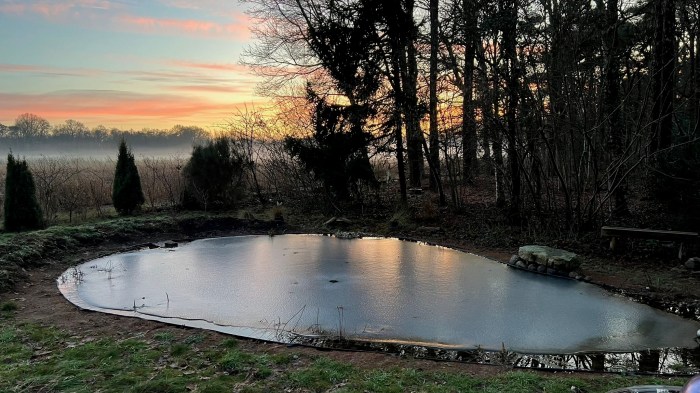
I do an afternoon meditation, sit by the pond thinking of nothing, or take a power nap. Once a day, at minimum, I force myself to switch off completely, no matter how stressed for time I may be. If I don’t, my productivity goes into a sharp decline, to the point that I would have been better off taking the time doing nothing rather than spending hours slogging on.
Mixing it up
There you have it. Four ingredients to choose from and mix them into an active but balances daily rhythm. It is this balanced mix of different kinds of activities, including doing nothing, that give me the satisfying feeling that I am not just achieving my goals, but am also enjoying the journey, while maintaining a lifestyle I want, without completely wearing myself out in the process.
You know what the most surprising part of all this is? I have found myself, over time, doing less, while achieving more. The stricter I am with sticking to this mix of things to work on and the more I stop myself from pushing myself beyond my own limits, the more I get done that really matters. Making a difference, while enjoying the journey. Moving forward without wearing out.
It’s highly recommended.
@2026 Bard
 The Dragon and The Phoenix
Thought provoking, thanks for sharing!
And I can’t help myself. I see four categories and my mind goes to the 2×2 matrix to clarify my understanding the four in different ways. That ended up in this model. And I am playing with words on this model, assisted by AI. I wanted to make this a non-judgemental matrix without low or high.
[image: image.png] Where:
Homeostasis is the drive to maintain equilibrium, find comfort, and return to a stable baseline – Heterostasis is the drive to intentionally disrupt your comfort zone and seek out stimulation – Hedonic is the presence of positive emotions, the absence of pain and immediate satisfaction – Eudaimonic is about functioning at your highest capacity involving effort, struggle and discomfort in the short term.
Is it useful? Not sure! As a mechanism for thinking about the four categories and their relationship to each other I found it helpful to consider why I do each of those things. Hope it is useful to you.
Hope the heat is not too bad for you (from NZs mid-winter!)
Alan H
Phone: +64 27 584 1178 Email: alan@hesketh.kiw alan@hesketh.kiwii á§
LikeLike
I like the matrix you came up with, Alan, and it did give me some new ideas to add to this topic.
For instance the tension between homeostasis and heterostasis is the main driver for the learning loop that makes life (all life) a continuous learning experience. Life seeks homeostasis, but that state is never perfect. The imperfection of the peaceful moments causes unease that rises till it triggers a response to restore the balance. The new balance will never be exactly the same as the previous one – with so many variables affecting us, there will always be differences, sometimes small, sometimes big. By evaluating the effectiveness of the response and the differences between the two moments of homeostasis our systems fine-tune their response patterns, constantly trying to get more effective and efficient at restoring the balance.
As for hedonic versus eudaimonic: people often mistake bliss for happiness, but they are not the same. Bliss is hedonic – a sea of positive feelings, fed by a mix of reward hormones like dopamine, endorphins, serotonin, and oxytocin. But rewards only work well when they are the result of effort, struggle and discomfort, to use your words. Happiness is a state of mind that comes from accepting and embracing the fact that strain and bliss are two extremes on a single cycle that cannot exist without either.
About the heat: we live in the far north of The Netherlands and have been spared the worst of the heat so far. And as a trained Queenslander I don’t flinch at temperatures in the high 30s. How is the winter in NZ at the moment? Paulina and I visited South Island last year October and loved catching the last of the snows in the Alps.
LikeLike
I do like to visualise things as I find it changes my perspective on content and helps me think about other order effects. I hadn’t seen the part played by the learning loop, and it led me to thinking about the impact that external events have on my position in the model. I know when things get pressured I “retreat” to necessary maintenance – somewhere I feel I have most control and can get a quick sense of achievement.
Really useful thoughts, thanks Bard.
And winter in NZ is very wet this year. We have an increasing numbers of atmospheric rivers coming from the north over NZ, so 100 year floods are now 1 or 2 year floods. Warmer seas mean more rain. And our snow fields are having to spend increasing amounts on making snow to keep their fields open. Some of that is just extending the ski season, with a lot due to warmer termperatures. Oh joy!
LikeLike
Oh that is annoying. The image is only recognised by a Placeholder. Any idea of how to get an image shown?
LikeLike
I am not sure why the image doesn’t load for you. It shows up on my side (on multiple devices) so it may be a setting on your side.
LikeLike
Must be. I’ll see what I can find out.
LikeLike