The Unkindness of Strange Systems

I had planned to write a long-ish follow-up to a previous post about kind strangers, adding some examples of people going the extra mile to ensure my wife and I came home safely after our ordeal with our car’s sudden death.

Unfortunately, the days after the event were filled with the opposite experience: unkind systems practically designed to make our lives as difficult as possible.

I found myself caught between 5 or 6 different parties, all supposed to help us resolve the unfortunate situation we are currently in: at home in a rural area, far from public transport, without a car for a period of time that could last days or even weeks. The solution is seemingly simple enough: if we could get a replacement car for the duration of the repairs, there would be no real issue. But 6 parties, with at least a dozen systems to work through between them quickly turned this into a Kafka-esk labyrinth with nothing but dead-ends.

The lease company pointed out the car is still under warranty, so it’s the supplier’s responsibility to provide us with alternative transportation. The supplier referred us to the dealer who is carrying out the repairs. The dealer tried to help us but discovered his system doesn’t allow him to book a car for us, since I am not registered as the owner of the car – the lease company is. The lease company then tells me they can activate our insurance, and make a claim through them. But the insurer says their system cannot take action until an official damage claim has been put in. I would be happy to do so, but was told the repairing dealer was the only one who could do that – after having carried out the repairs. Only then could a replacement car be requested, except, of course, that wouldn’t be necessary any more, since by then the car would have been fixed and ready to be returned to us.

By the end of the day I have had conversations with the lease company, the supplier, the dealer, the tow truck company, the insurer, and a rental car company … every time getting stuck on similar systemic issues. It is evening here now, and so far, nothing definite has been decided. With so many unkind systems to throw obstacles on our path, it could be days before we have a solution.

I am sure it will sort itself out eventually. But what is striking is the difference between the kind strangers willing to bend the rules to assist us and get us safely home, and the unkind systems messing things up. I can only assume their unkindness is not deliberate. And I have no complaints about the operators I talked to, all trying to their very best to find a solution. But each system was designed to solve a small part of a much larger puzzle, with no real understanding of the total complexity. Built around assumptions, and rules based on those assumptions, that cover an even smaller part of the puzzle – the part in which everything goes according to plan. Which it seldom does.

The Kindness of Strangers

A few weeks ago, on the way back from our shopping round, our car started playing up. The automatic brake system started engaging the brakes at random moments, which was scary enough, before all kinds of warning lights appeared on the dashboard, followed by a warning in bold letters on a bright red background that told me the car would start an emergency shut down in 15, 14, 13, …. seconds, inexorably counting down while I was frantically looking for a safe place to take the car off the road.

We almost made it to safety. The car was half on the shoulder of the road, with only a bit of the rear still sticking out when we reached 0 and the car completely died on me, in the process locking the brakes and the steering wheel. It could have been worse, at least most of the car was off the road, but the bit sticking out, on a 1.5 lane road, in a bend flanked by trees, was dangerous enough to have us worried. Whatever I tried, I couldn’t restart the engine, nor could I unlock the brakes and steering mechanism.

Within minutes, a van stopped behind us, the driver got out and asked if he could help. We tried pushing the car further into the shoulder, but it wouldn’t budge, so he apologised profusely, before driving on. The next person to offer help was a local farmer who had been told someone had parked a car on the edge of his potato field. He was very friendly, too, and suggested some numbers we could call to get expert help.

So we called roadside assist (ANWB, for those that know the Dutch system) and waited, hoping no-one would hit us from behind, or cause a head-on collision by steering around our car without checking if anyone was coming from the other direction. Truth be told, there were some near-misses, but no actual crashes.

About an hour later the ANWB guys showed up. He introduced himself and then spent the best part of an hour running all kinds of diagnostics trying to resuscitate our defunct vehicle. To no avail. We had to call a tow truck and were told it would take at least another hour before one would arrive.

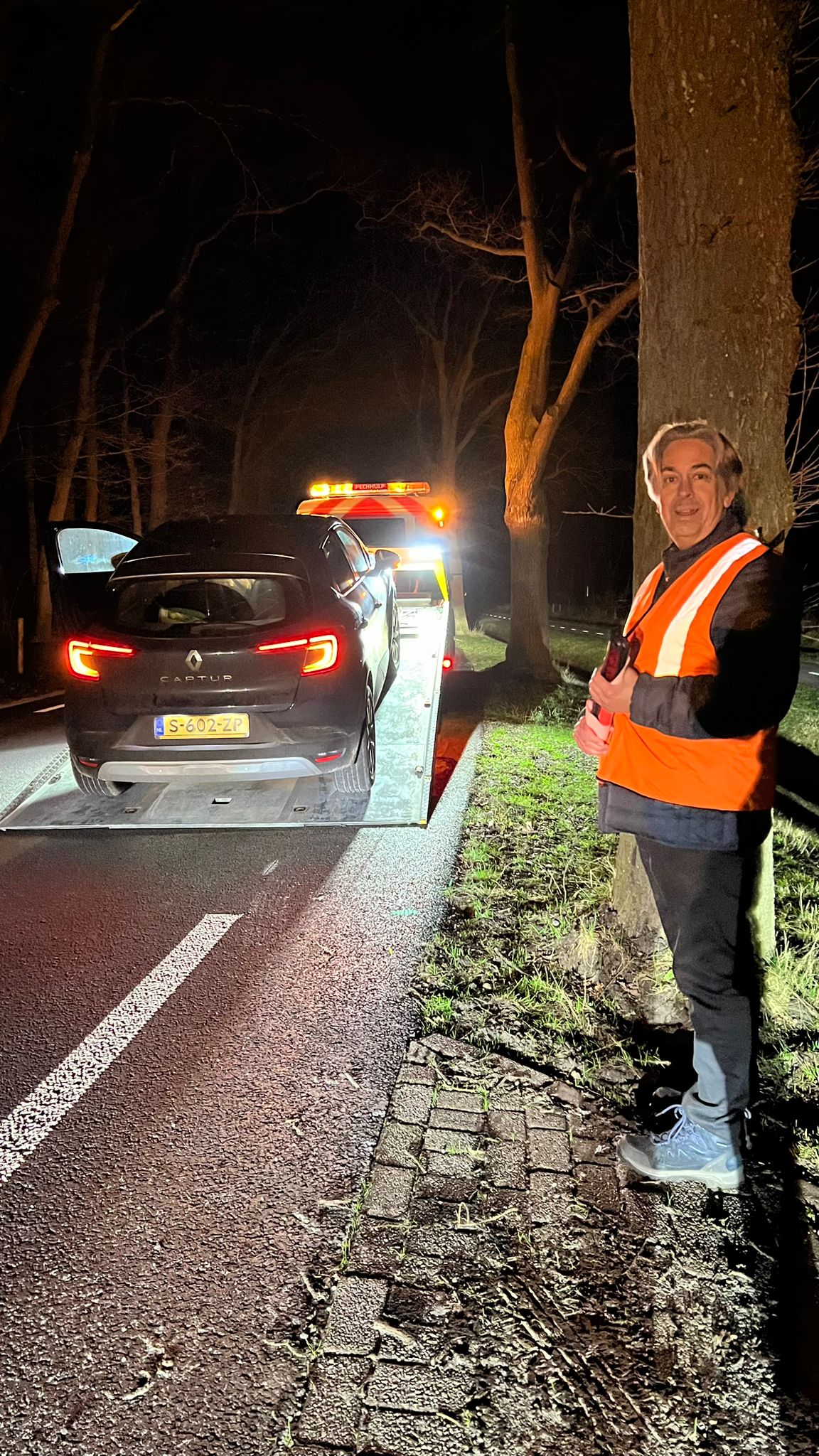
To our surprise, the ANWB guy decided to wait by our side. He had turned on the rotating alarm lights on his van and put a series of witch’s hats around our car to make sure no cars would crash into us. And, as relaxed as could be, we then had a very engaging conversation about his work, my work, the state of the world, even politics and a bit of religion, all in a most amicable atmosphere, almost if we were old friends having a yarn over a beer. When the tow truck finally arrived, with the help of the ANWB guy, our completely dead car was successfully loaded onto the tow truck.

He didn’t have to do this. He could have packed up and moved on hours ago. It was pure kindness and helpfulness that made him stay by our side and I will always be grateful for that.

Below you see me carting away our shoppings in a wheelbarrow we had just bought, not knowing it would come in so handy :-).

My Country of Birth is Reclaiming Me

My Country of Birth is Reclaiming Me

I have been somewhat absent from this blog in the past 2 years. Not completely, but I was far less active than in previous years.

One of the reasons is the fact that circumstances largely beyond our control have forced my wife and I to relocate back to the country we were born in, The Netherlands, and leave our country of choice, Australia, behind.

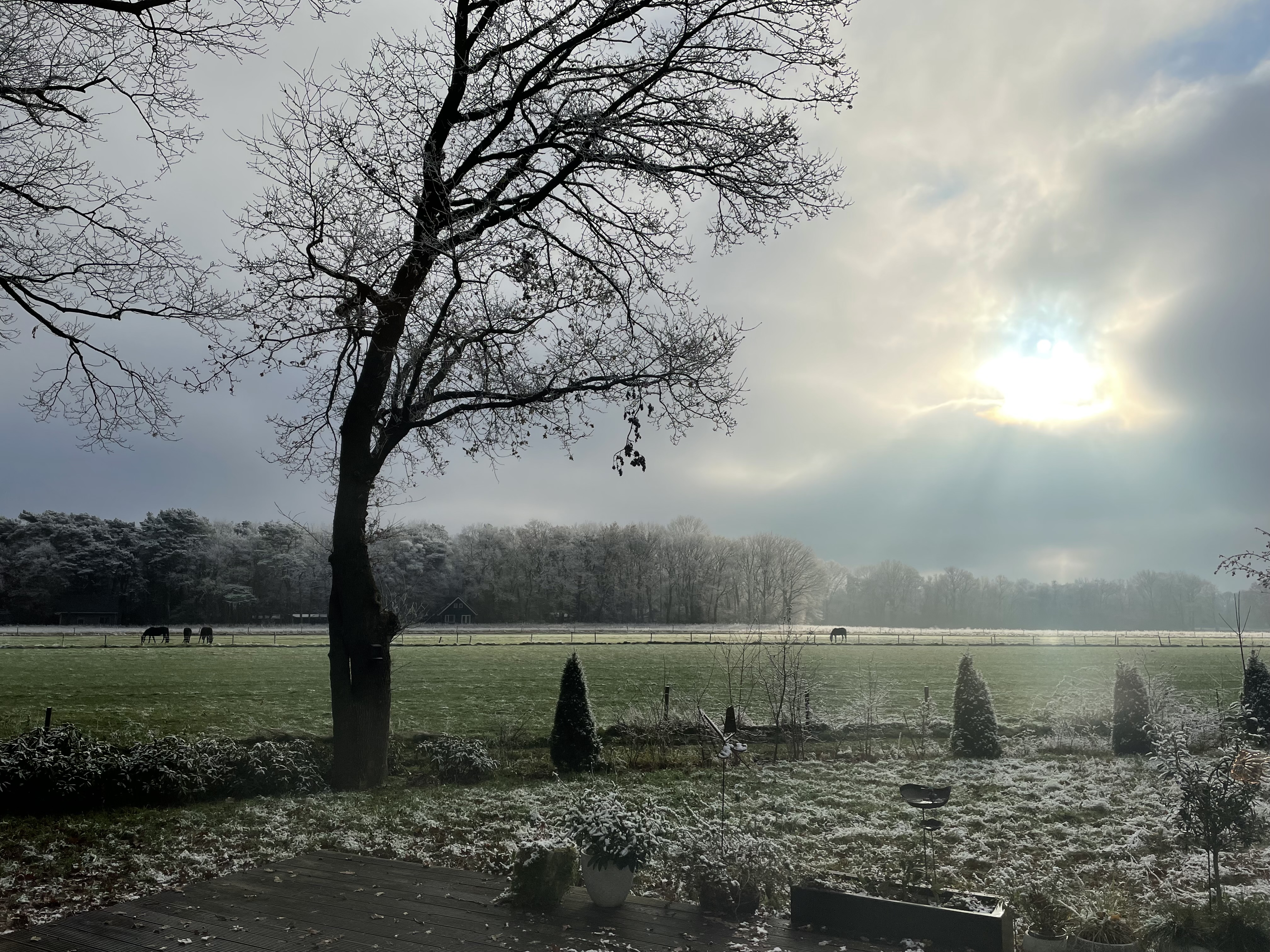
That process, happening in the midst of the COVID pandemic, was messy, hectic and rather painful at times. But the transition is behind us now and we are settling into our new home, in a beautiful forest in the north of the country.

One interesting thing I am noticing is how the country seems to be reclaiming me. After living in Australia for more than 20 years, I felt (and still feel at times) more Australian than Dutch. I came back to this country feeling a stranger in a strange land; a visitor to a country that didn’t look much like the country I left behind in the previous century.

But in the past few months, that feeling has been changing. Gradually, I beginning to feel my old roots – the ones I thought I had severed and discarded when I migrated to Australia – come to life again and take hold in the soil of the forest around me. I am beginning to recognise the feel of the sand under my feet, the sounds of the birds and insects, the smell of the grass and the surrounding trees. And I am beginning to feel Home again.

What makes this process interesting to me is that it is not the nation or its people that is reclaiming me, but its Nature, its soil, its COUNTRY, as the Australian Aboriginals would call it. It is a feeling that had slowly grown on me in Australia, but – because I wasn’t born there – would never completely take hold: that of belonging to country. Here in The Netherlands, I feel I am welcomed back and told I do belong here; that I never stopped belonging here, no matter how far away I was.

For me, this is an important reminder of how deeply intertwined we really are with Nature, with the land on which we are born, live and die. We are not separate from Country, we are its offspring, and tied to it through many, many invisible roots and connections. We may have created this illusion of man vs. nature, or man over nature, or even man completely separate from it, but we are, in our core, just another form of Nature. Nothing more, nothing less. Only when we acknowledge that and let our country fully claim us as its own can we be truly happy and in harmony with ourselves and the world.

Here is to coming Home and being reclaimed. Here is to Country.

Happy New Future.

One Fine Day – Now available on Amazon

For all those wondering where my short stories have disappeared to: they are now available in Kindle, Paperback and Hardcover format here: https://www.amazon.com/dp/B0B6RP4K9G/ref=cm_sw_em_r_mt_dp_4BMMHAHVD22T8VMG4V7G

Go check it out. 16 intriguing stories with handcrafted illustrations by the author himself.

100 Questionable Assumptions – 7

Prehistoric Morons

Our prehistoric ancestors were simple people, speaking in grunts and chipping away at rocks

Just some rocks thrown together by primitive stone-age people - ©Bard 2018
Just some rocks thrown together by primitive stone-age people – ©Bard 2018

It is a miracle the human race survived at all. With their limited intelligence, primitive mindset and total lack of technology, their survival under some of the most impossible circumstances most have been dumb luck. Any evidence of global trading from prehistoric times should be attributed to nothing more than the random stumbling about of simpletons. Their megalithic monuments are just a product of brute force and stubbornness. It’s a good thing we modern humans have evolved so far beyond our brutish, stupid beginnings and are so much smarter than our primitive ancestors.


Let’s imagine, just for a moment, that you were transported back in time, to the world our pre-historic ancestors lived in. Surely you, with your superior intellect and sophisticated technological knowledge would soon be able to lead those poor dimwits out of their Stone Age into an Age of Enlightenment.

Or would you?

How much of the technology you have come to rely on do you actually understand? Do you know how to make even the most basic of the tools that are part and parcel of our modern world?

And how resilient are you, really, without any of those tools readily at hand? Would you be able to find and prepare food straight from Nature? Would you be able to navigate dense forests, vast open steppes, and even medium-sized seas without your technological crutches? Do you know how to carve a megalith out of a sheer cliff face, let alone how to transport it for 100s of kilometers, and then place it upright in a way that will last for millennia?

Before you assume you would easily become the King of the Stone Age people, consider this: not only did they survive and often thrive in situations you would perish in within minutes of your arrival; they did so using mostly their own brains, cunning, muscle-power, and verbally transmitted lore. All of the daily challenges you need modern technology for — technology invented by others, made by others, and kept running by others — they would have to find solutions for themselves.

Who is the clever one now? You, who can Google anything you need to know, stay in touch with 100’s of friends you never actually meet, and program a microwave to cook the perfect frozen meal? Or the ‘primitive’ Stone Age human, who had to remember 1000s of lines of verbal tradition, could survive solely on what Nature provided, and still managed to traverse the globe, and leave monuments that will outlast almost anything modern humans have produced?

100 Questionable Assumptions – 5

Informed Decisions

More information automatically leads to better decisions

Making choices can be difficult - ©Bard 2016
Making choices can be difficult – ©Bard 2016

The more I know about something the better I can weigh my decisions: instead of having to guess and assume, with enough information I can simply reason my way to the best decision. With all the information at my disposal I will always make the right decision.

But is this true for all decisions? When there is only one choice, the decision is obvious. When there are two options, one of the two usually stands out as the better choice. When there are five choices, however, making a decision becomes difficult and I need information to work out what is best. When there are dozens of choices, the decision is complicated, and I need a lot of information to work things out. When there are a hundred choices or more, the choice is now complex, and even a single new bit of information can completely change the outcome. What exactly is the best decision when the outcome changes with every new bit of information and the information available is never complete?

Is the constant demand for more information an example of believing you can never have enough of a good thing? Sure, without any information at all, your guess is as good as mine – or as random. So a bit of information can be helpful. But piling up information from different sources, of varying quality, of variable levels of relevance, does that clarify things for us, or does it merely confuse us?

Maybe we need to come to terms with the limits of our decision-making abilities, and the limits of what information can do to improve them? Maybe we live in a world that is too complex to fully fathom and all we can hope for is on average to get things more ‘right’ than ‘wrong’, trusting that we have more than just our rational thought processes to guide us; and trusting that in a complex, highly dynamic, and never fully understood reality even our ‘wrong’ decisions can be portals of discovery leading to completely new and unimagined opportunities?

100 Questionable Assumptions – 4

The Trickle-Down Economy

Concentrating wealth in the hands of a few increases the total wealth available to all

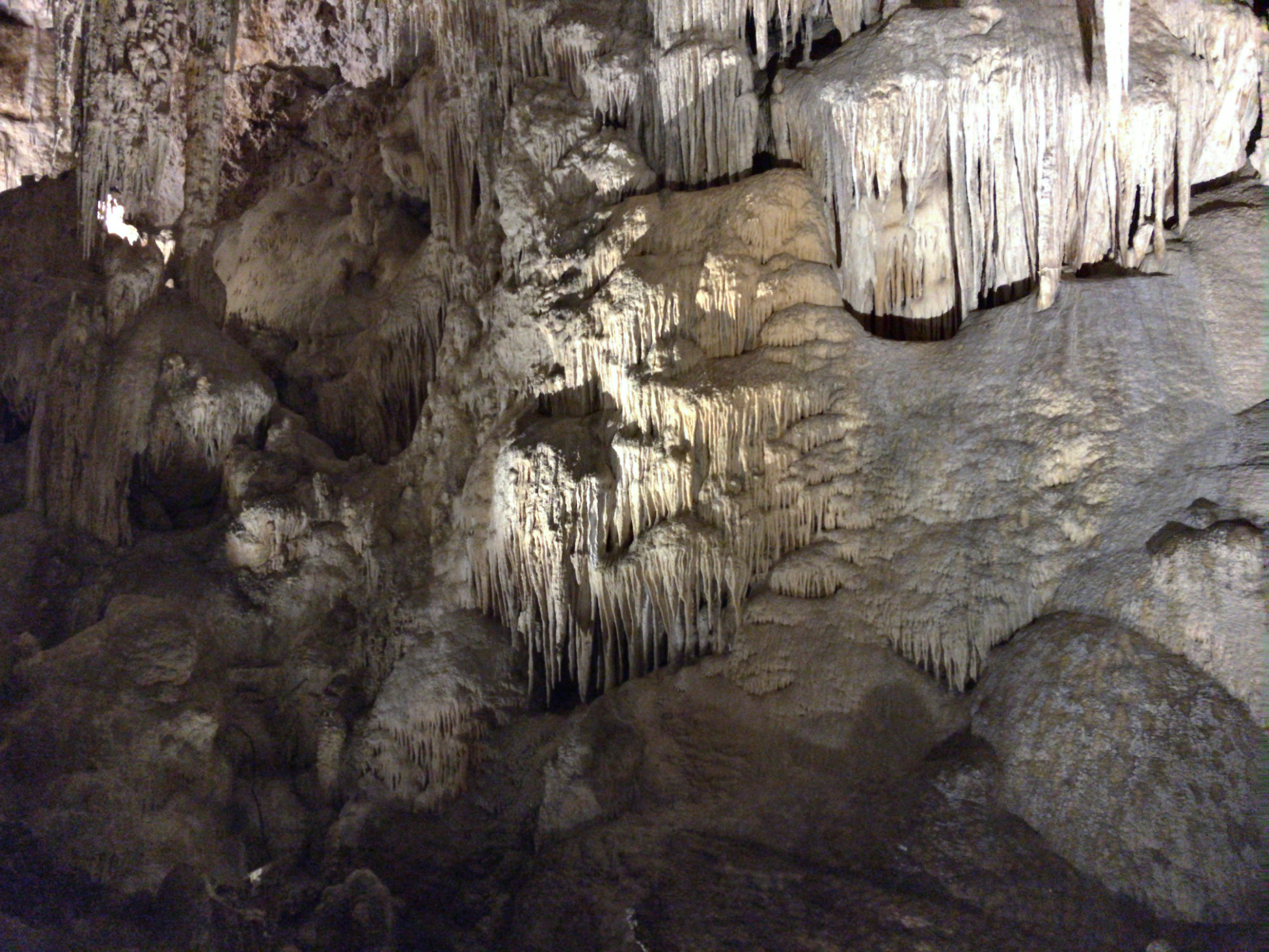
Too much food on not enough tables - ©Bard 2005Too much food on not enough tables – ©Bard 2005
When the total sum of wealth in the world increases, should we care about its distribution? We are all related, and everything is connected, so when the wealth of the world increases, the whole world is better off, even when only a lucky few benefit directly. Feeling left out and disadvantaged is just a narrow-minded, selfish reaction of the misguided ego that fails to see the bigger picture. A rising tide floats all boats, they say. And the trickle down principle works better when there’s more at the top to trickle down from. So let’s just keep slaving away at increasing the size of the pie, and not look too closely at how the slices are divided.

But if all the food of the world ends up on one table and the rest of the world is starving, does it really matter how richly stacked that table is? Does it matter how big the pie gets, when its parts are shared more and more inequitably? Does it benefit the world that a lucky minority can waste water on pools, parks, and fountains while the masses are dying of thirst? Is it right to boast of our fabulous cities and technological marvels while the rest of the world is turned into a wasteland to make those wonders possible? Does concentrated wealth really count as wealth, or it just another name for distributed poverty?

There is something deeply flawed about our current economic models. It all sounds really good in theory: in a free market, with all players having equal access and the freedom to choose, supply and demand, surplus and shortage, production and consumption will all balance themselves out in a dynamic equilibrium. The most deserving will get a bit more, the most productive will make the most profit, while the least productive and least deserving will get a bit less. But that is only fair, and much more fair than any centrally led economy or government-regulated system could ever be.

For a long time I have tried to believe this narrative, in spite of the plenty of evidence to the contrary. I wanted to believe the fundamental theory was sound and that a free market was – in theory – the best solution to our economic needs. I tried to explain the obvious failings of the system – the rising income inequality, the massive environmental damage, the overwhelming power of the wealthy elite over the poor majority of humanity – not as a flaw of the system but of the people running it. It had to be because of bad people, corrupt politicians, greedy businessmen, and criminal governments that the system refused to balance out. Surely, if we could find a way of weeding out the bad apples that were ruining the beauty of the free market, everything would work out OK?

An article in this month’s Scientific American, titled “The Inescapable Casino”, changed my mind. What the article claims, using fairly simple mathematics, is that the free market theory is fundamentally flawed. Even a truly free market, untainted by the distortions and machinations imposed by bad and greedy influences, will not move towards a balanced distribution of goods and value. Instead, small ‘errors’ of value exchange – where one party receives slightly more value than they should – build up over time. Once the value distribution is skewed, the unfair advantage of having received slightly more builds up over time, invariably leading to a lucky few owning almost everything, with only a few scraps left over for the rest. Instead of trickling down, the authors state, a free market tends to trickle up: shaving off value from the poorest to add to the increasingly disproportionate abundance of the rich.

For me, this insight changes a core part of my own thinking about our economic future. The flaws in our system have always been obvious to me, but I kept thinking we could correct these by limiting the damaging influence of the bad people involved. I was hoping that a free market without their distorting influences would be possible, so we did not have to rethink the entire foundation of our current economy. But I am coming to the conclusion this was a naive and idle hope. The system itself is fundamentally flawed. Even without ‘evil’ influences in it, it will never lead to a just and fair distribution of wealth and power.

But hidden inside this realisation is some (perhaps unexpected) good news.

It means we can change our focus. Instead of fighting the bad people and thinking up ways to limit their evil ways, we can turn our minds and energy to solving the real problem. Fighting evil people may give us the satisfaction of righteous indignation and moral superiority, it will not, however, solve our current problem of income inequality and massive over-concentration of wealth. It may smoothen the curve a bit, and soften some of the edges, but it cannot ‘cure’ a system that is so fundamentally flawed. We need to find a better system if we want to have a sustainable future. We need a system that is fair, balanced and equitable at its core.

So, let’s keep calling out bad behaviour and abuse of power where we see it. But let’s stop blaming bad people for all the problems in our world. They may be taking advantage of it but they are not the cause of our economy’s failings. The root cause is our economic system itself. Finding a better system should have our full attention and complete devotion. This is not a matter of winning a battle between good and evil. It’s a matter of finding a way of life that offers us a future.

100 Questionable Assumptions – 3

Perpetual Growth

If growth is good, continuous growth is better, slow growth is bad, no growth is a disaster

Slow growth can be beautiful, too - ©Bard 2017
Slow growth can be beautiful, too – ©Bard 2017

When things grow it means they are getting bigger, stronger, more. The faster they do so, the better it is. Failing to get bigger, stronger, more – even for a moment – must mean falling behind in the race towards dominance. Losing that race means death. When we look at Nature, growth is a sign of health and vigour; of youth and potential. As long as things grow they thrive. So, with Nature showing us the way, isn’t it logical – natural even – that we humans strive for perpetual, ever accelerating growth?

Or is it? Most things in Nature do not grow all the time, but slow down, decline, and die. In Nature things have a natural limit to their growth, to keep the eco-system diverse and balanced. Only pests, diseases, and cancers don’t seem to obey this rule, and end up destroying the very environment that gave them life. Maybe ours is the choice between growing up or growing on: finding peace with our world or finding ourselves without a world at all?

What if bigger, stronger, more are not the dimensions we should focus our efforts on? What if there are other forms of growth we overlook? Growth in complexity, variety, experience, wisdom… Could it be that our obsession with material growth is blinding us to the real growth opportunities around us?

100 Questionable Assumptions – 2

The Mechanical Enterprise

An enterprise is like a machine we design, build, and operate 

Like a train speeding towards the abyss - ©Bard 2016
Like a train speeding towards the abyss – ©Bard 2016

An enterprise is very much like a machine. It is engineered to perfection. Powerful and unstoppable, if properly constructed if will fulfill the function it was designed for without hesitation or deviation. Like a train it will thunder down the track its masters lay down for it, squashing all that comes in its path.

If this were true, why do Enterprises so often surprise us? Why is there no guaranteed best formula for creating and running an Enterprise? Why can good companies turn bad? Why do winning Enterprises stop being successful?

Is it because the machine of Enterprise is being operated by humans and those humans are fallible, unpredictable, flawed? If that were true, the less human interference we need, the better our Enterprises would become. The perfect Enterprise would not need any human operators at all. The perfect Enterprise would be perfectly engineered to perfectly run without human intervention.

Or could it be that the reality our Enterprises operate in is not a mechanical reality? Could it be that the complexity of the Enterprise’s environment defies a full analysis, complete enough to robustly design the Enterprise for all the variables and variations it has to deal with in its existence? If that is the case, no purely mechanical approach will yield a workable Enterprise. Resilient, intuitive, intelligent, unpredictable people will always be needed to steer the Enterprise through the frothy waves of complex reality. The perfect Enterprise would be approximated but never complete. No design, however detailed and well-thought-out can capture all the possible variations branching out at every future moment. Without humans to give it life, purpose, awareness, and responsiveness it would remain a perfectly lifeless abstraction, incapable of sustaining itself in the real world.

There is plenty of reason to believe reality is too complex, chaotic even, to be fully predictable. Why then are we still trying to refine human action and human agency out of our Enterprises’ design and operation? Why do we keep thinking that less human control and influence equals more effective operations?

Isn’t it time to stop that train before it takes us over the edge of the abyss?

100 Questionable Assumptions – 1

This is going to be a series of assumptions I believe we should not always take for granted. They may be true sometimes, they may sound quite obvious, but are they always right? I am not claiming they are never true or useful, just arguing we should occasionally stop and question them. If we never critically examine what we assume about the world, how will we ever correct the flaws in our thinking?

1: Unlimited Wealth

If wealth is good, limitless wealth is infinitely better

Bard - ©2016
Bard – ©2016

Can you ever have too much of a good thing? If wealth enables people to do great and good things, limitless wealth should enable them to do an unlimited number of even greater and better things. But many great and good things are not happening in the world right now, whilst many deplorable and bad things are.

Why is that?

Is it because the wealthy are not wealthy enough? Are we limiting their ability to do all the great and good things they would do if only we let them grow even wealthier?

Or maybe wealth itself is not enough. Maybe wealth needs the human spirit to turn its potential into good. Maybe strong spirits with limited wealth can do great things, where weak spirits with great wealth do little good at all.

Maybe, when focusing on growing wealth, we are focusing on the wrong side of the equation? What would happen if we focus on developing the human spirit? If we encourage our children to be compassionate, fearless, strong, kind and caring before we teach them to be selfish, afraid, needy, greedy and aggressive? What would happen if we change the rules of the games our society plays by, so that wealth is not automatically equated with success, and money is not automatically equated with power over others?