Loyalty is often touted as a positive emotion, something to be admired and rewarded for. Yet loyalty has been the cause of suffering throughout known history and probably long before as well.
Loyalty pressures the individual into sacrifice and suffering ‘for the greater good’. Loyalty motivates groups into discrimination, exclusionism and violence towards ‘others’. It can even lead entire nations into waging wars and committing acts of mass murder and genocide, driven by the conviction that this is the loyal thing to do.
I have always wondered why loyalty was so often expected of me in contexts I didn’t sign up for. I didn’t choose to be born where I was born. I didn’t choose to belong to the religion of my parents, grandparents, and beyond. I didn’t vote for the crazy leaders ruining the countries I have lived in. Yes, more often than not, I was told I owed some sacred duty of loyalty to my family, tribe, religion, country and leaders, to the point of being expected to commit acts of violence against others and even happily give up my life in service of those nebulous but apparently deeply sacred construct I supposedly belonged to.
It seems to me that loyalty to any particular group is always a dangerous proposition, as it automatically and unavoidably means excluding other human beings from my duty of care. Loyalty to ‘us’ always means turning away from ‘them’; the others that are a threat to us, want the good things we have, and would rob, enslave or kill us is we gave them even half a chance. Any care, empathy or concern I might feel for those others, I am constantly told, means disloyalty to those I should think of as mine. As if my capacity for loving kindness is too limited to be wasted on outsiders.
I have always deeply mistrusted loyalty as a motivator, especially as a motivator for exclusion, distrust, violence and hate. Of course, I feel a special fondness and connectedness towards those who are close to me. Of course, I feel gratitude and even a sense of indebtedness to my ancestors who worked so hard and often suffered in order for me to live the beautiful life I am living. I have no problem with being asked to do something in return; to make positive contributions to my family, tribe and nation. But my loving-kindness, my capacity for helping others, my compassion for any life that is suffering is not limited to my in-group only. I see no reason to exclude any living being from my duty of care or compassion. All life is one, as far as I can see, and therefore has an equal claim to my loyalty and love.
No living being of any kind deserves to be excluded, neglected, humiliated, enslaved or killed just for being not us.
For a long time now I have been worrying about saving the world. It sure as heck needs saving, but my attempts at doing so have not made much of an impact. At least from what I see in the daily news.
But then something happened that changed my perspective.
We moved into a new place, surrounded by a forest property. The forest needed attention. Some trees are dying, other parts are being taken over by an aggressive, invasive species, we need more diversity, we need some tracks to make the property more accessible… It felt like another big project: saving the forest. Of course, what it came down to in the end was to just pick something small, and start there. We planted some saplings, we removed some of the invasive trees, we started clearing a track. One little step at the time. And now, just over a year later, we are beginning to see the fruits of our labour. In very small ways the forest is starting to look better, more vibrant, more in balance.
None of the changes we made are really big. And most of the improvements we see are simply nature doing its thing. But the small things we are doing have just enough impact to help nature do so.
So, more and more now, I tend to look for the tiny differences I can make on a daily basis, trusting that the big things will take care of themself. I nudge rather than change things; I support rather than push things; I encourage rather than force things.
I still don’t know if I am saving the world, but I am certainly saving my sanity and gaining a healthy combination of humility, fulfilment and peace of mind.
So, don’t come to me expecting big, world-changing results. But if you have something small, positive and worth doing, I’ll be happy to support you. In whatever little way possible.
I often wonder about humanity’s tendency to choose and follow petulant kings and childish tyrants; not just allowing them to rise to power, but enabling them to commit abhorrent crimes against humanity and destroying whole civilisations, not seldom including their own.
You would think that a tendency to choose bad rulers would, over time, be bred out of our genes. What evolutionary benefit can there be in this penchant for leaders that do more damage than good? Yet, we fall for the same types again and again.
Why? What mechanisms are at play here that not only let those types rise to power but help them grow their power to ridiculous heights, even when their childish and destructive behaviour is clearly visible to any discerning adult?
Since this pattern is so common across civilisations, I suspect it must be encoded deep in our DNA. I can only speculate – since we don’t really know how our DNA encodes our behaviours – that petulant kings and childish tyrants rely on the misapplication of otherwise healthy and necessary instincts.
Humans have deeply ingrained parental instincts, for example, that lead us to want to protect and care for helpless infants. Maybe infantile tyrants trigger that same instinct, in an exaggerated and dysfunctional way, like oversized and unnaturally brightly coloured eggs trigger a fanatical breeding impulse in birds. This could make us want to protect and even cherish an overtly childish and irresponsible leader.
Another pattern I suspect is our instinctual longing for the superhuman parent we lost when we grew up and saw our parents exposed for the frail and flawed human beings we never thought they were. There is something deeply comforting in the belief that our parents are all-knowing and all-powerful. It allows us to be the innocent child, powerless but safe under the protection of beings far superior to us.
Maybe we all still long to be that child, bowing in awe to the will of our superhuman parent. That could explain why we are drawn to individuals that openly and defiantly break laws, rules and social conventions. It would make irresponsible, boastful and arrogant leaders strangely attractive to the inner child we lost in early childhood. It would also explain why kings and tyrants through the ages have always been portrayed as larger-than-life, close to God or Gods, and possessed with magical and mystical powers.
David Graeber and Marshall Shalins in their book “On Kings” argue that we don’t want our kings and rulers to obey the law but to stand above it. A king that is constitutionally limited lacks that superhuman, even supernatural appeal that a ruler that answers to nothing and no-one seems to have. If I see what tyrants historically got away with, and often still do, it could be because of their followers’ need for someone who is truly above all human laws. That could be an echo of what the powerless child saw in its parents before they fell from grace.
The paradoxical combination those two instincts – the drive to protect and cherish our children, triggered by adults that behave like over-sized toddlers and the need for superhuman parent figures, triggered by ruthless individuals openly flaunting laws and conventions – can explain the fanatical devotion and protectiveness paired with unquestioning obedience you so often see destructive tyrants and misbehaving kings surrounded with.
If my suspicions are true, humanity is constantly at risk of being tricked by some of our deepest instincts into admiring, enabling and obeying deeply flawed, psychopathic and destructive individuals. Not because we consciously choose to do so, but because our instincts drive us to it.
So, what can we do about it? Are we doomed to fall for infantile bosses and ridiculous rulers forever?
I certainly hope not. I believe we are more than our instincts. I believe we can train our self-awareness and self-control to recognise and self-correct when our instincts trick us and are being used against us. I also believe we can shape our culture – the shared assumptions, behaviours and stories that our society lays on top of our instincts – to protect us from such abuse and trickery. It does mean we cannot let our culture be dictated by those who want to take advantage of such manipulation. We must, collective, choose to steel ourselves against the abuse of our vulnerable instincts, so we are less inclined to run blindly after rulers that lead us astray.
For a few weeks, we had a rental car on loan while waiting for our lease car to be repaired. The rental car was organised by the dealer, not, as I expected, by the lease company.
Several people reacted to my story about the lease company’s reluctance to keep us mobile after our car malfunctioned. A common assumption was that a lease contract is a DAAS (Driving as a Service) agreement. The car shouldn’t matter, what should matter is that we would stay mobile.
To be honest, that was also my assumption when I signed the lease contract. Or, to be more precise, when I signed the lease agreement, which was a shortened version of the full contract. The full contract was available on the lease company’s website. I remember looking through it at the time but not taking the time to read the whole thing, as it was many pages long and written in the kind of small-print legalise that makes your eyes water and your head hurt.
As it turns out, my understanding of the agreement I made with the lease company doesn’t quite match their understanding of what we agreed on. The basic contract is little more than a financing deal, with some additional services thrown in around maintenance, insurance and a financially attractive way to switch to a new car after a few years. Whereas the lease company’s website and informal communications are full of promises around ‘driving without the hassle’, ‘carefree driving’, ‘removing the burden of ownership’, etc. the actual contract has been carefully constructed to outline quite a few conditions, exceptions and caveats that undermine those promises. Had I taken the time and trouble to study the full contract before signing the agreement, I might have negotiated a different agreement, or go to a different lease company.
What we are left with is a mismatch between my understanding of the deal and that of the lease company. Whose fault is that? Mine or theirs?
Legally speaking the fault is mine, of course. Though not included in the paperwork the lease company sent me, the full contract with all its clauses and attachments was available online. I should have studied that before signing the agreement.
Ethically speaking the answer may not be that straightforward. The lease company didn’t exactly advertise the fact there was a long and complicated contract behind the simple agreement form I signed, for instance. It was only hinted at in a footnote, printed in super-fine print, at the bottom of the (mostly empty) page. Obscured by their logo and some irrelevant company information. Almost as if they tried to keep me from reading it. And the contract itself required close-reading and a higher-education level understanding of English to fully make sense of what it stipulated. Some very smart lawyers must have heaps of fun finding creative ways of denying essential services while seemingly making them available.
I believe that a customer-focused company, one that really cares about the well-being and satisfaction of their customers should feel responsible for making sure their customers understand the deal they are signing up for, especially when that deal is complex and prone to assumptions and misunderstandings. In such cases moral considerations should inform their duty of care, not legal arguments fuel their tendency to not care a damn.
I had planned to write a long-ish follow-up to a previous post about kind strangers, adding some examples of people going the extra mile to ensure my wife and I came home safely after our ordeal with our car’s sudden death.
Unfortunately, the days after the event were filled with the opposite experience: unkind systems practically designed to make our lives as difficult as possible.
I found myself caught between 5 or 6 different parties, all supposed to help us resolve the unfortunate situation we are currently in: at home in a rural area, far from public transport, without a car for a period of time that could last days or even weeks. The solution is seemingly simple enough: if we could get a replacement car for the duration of the repairs, there would be no real issue. But 6 parties, with at least a dozen systems to work through between them quickly turned this into a Kafka-esk labyrinth with nothing but dead-ends.
The lease company pointed out the car is still under warranty, so it’s the supplier’s responsibility to provide us with alternative transportation. The supplier referred us to the dealer who is carrying out the repairs. The dealer tried to help us but discovered his system doesn’t allow him to book a car for us, since I am not registered as the owner of the car – the lease company is. The lease company then tells me they can activate our insurance, and make a claim through them. But the insurer says their system cannot take action until an official damage claim has been put in. I would be happy to do so, but was told the repairing dealer was the only one who could do that – after having carried out the repairs. Only then could a replacement car be requested, except, of course, that wouldn’t be necessary any more, since by then the car would have been fixed and ready to be returned to us.
By the end of the day I have had conversations with the lease company, the supplier, the dealer, the tow truck company, the insurer, and a rental car company … every time getting stuck on similar systemic issues. It is evening here now, and so far, nothing definite has been decided. With so many unkind systems to throw obstacles on our path, it could be days before we have a solution.
I am sure it will sort itself out eventually. But what is striking is the difference between the kind strangers willing to bend the rules to assist us and get us safely home, and the unkind systems messing things up. I can only assume their unkindness is not deliberate. And I have no complaints about the operators I talked to, all trying to their very best to find a solution. But each system was designed to solve a small part of a much larger puzzle, with no real understanding of the total complexity. Built around assumptions, and rules based on those assumptions, that cover an even smaller part of the puzzle – the part in which everything goes according to plan. Which it seldom does.
A few weeks ago, on the way back from our shopping round, our car started playing up. The automatic brake system started engaging the brakes at random moments, which was scary enough, before all kinds of warning lights appeared on the dashboard, followed by a warning in bold letters on a bright red background that told me the car would start an emergency shut down in 15, 14, 13, …. seconds, inexorably counting down while I was frantically looking for a safe place to take the car off the road.
We almost made it to safety. The car was half on the shoulder of the road, with only a bit of the rear still sticking out when we reached 0 and the car completely died on me, in the process locking the brakes and the steering wheel. It could have been worse, at least most of the car was off the road, but the bit sticking out, on a 1.5 lane road, in a bend flanked by trees, was dangerous enough to have us worried. Whatever I tried, I couldn’t restart the engine, nor could I unlock the brakes and steering mechanism.
Within minutes, a van stopped behind us, the driver got out and asked if he could help. We tried pushing the car further into the shoulder, but it wouldn’t budge, so he apologised profusely, before driving on. The next person to offer help was a local farmer who had been told someone had parked a car on the edge of his potato field. He was very friendly, too, and suggested some numbers we could call to get expert help.
So we called roadside assist (ANWB, for those that know the Dutch system) and waited, hoping no-one would hit us from behind, or cause a head-on collision by steering around our car without checking if anyone was coming from the other direction. Truth be told, there were some near-misses, but no actual crashes.
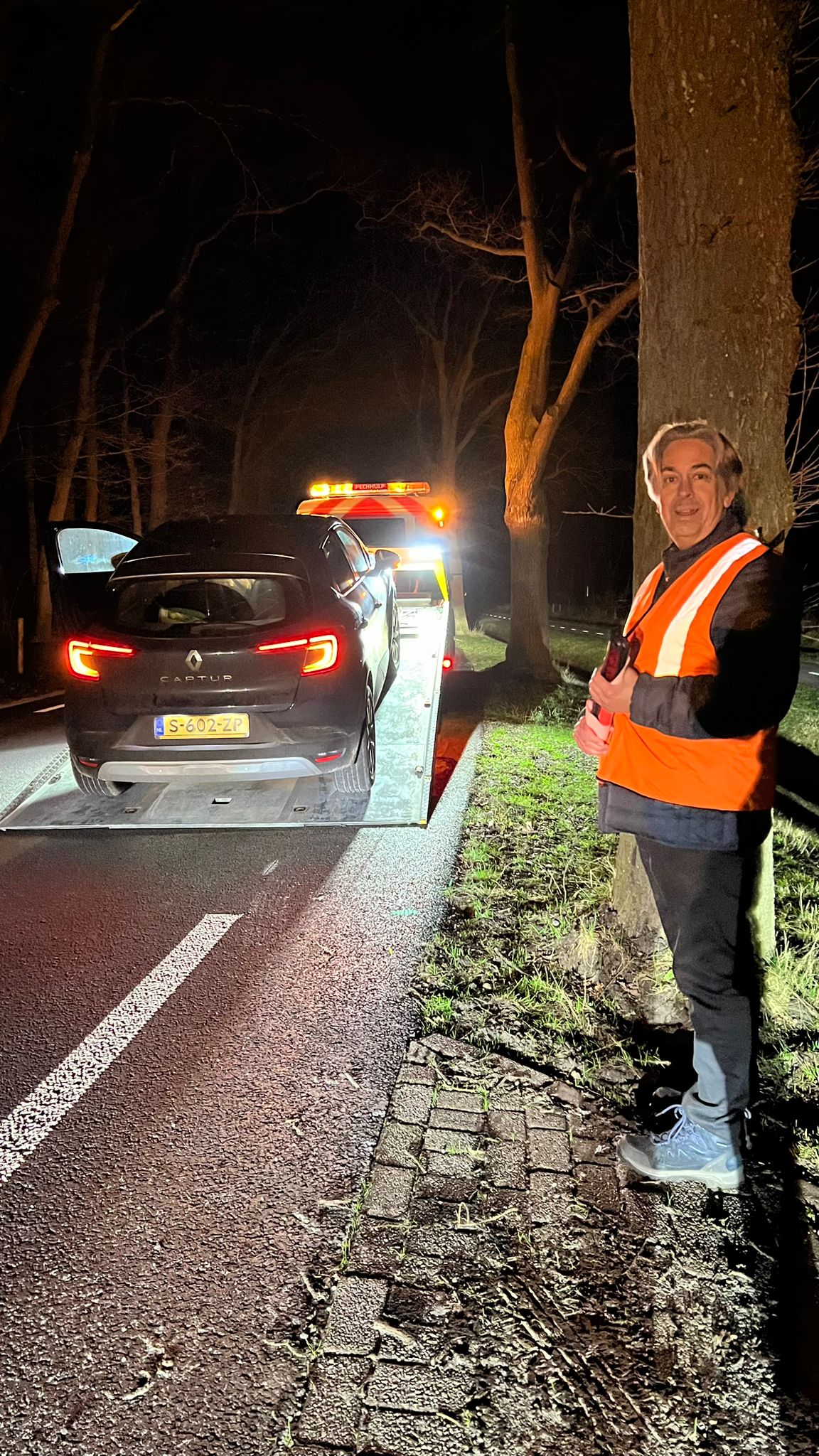
About an hour later the ANWB guys showed up. He introduced himself and then spent the best part of an hour running all kinds of diagnostics trying to resuscitate our defunct vehicle. To no avail. We had to call a tow truck and were told it would take at least another hour before one would arrive.
To our surprise, the ANWB guy decided to wait by our side. He had turned on the rotating alarm lights on his van and put a series of witch’s hats around our car to make sure no cars would crash into us. And, as relaxed as could be, we then had a very engaging conversation about his work, my work, the state of the world, even politics and a bit of religion, all in a most amicable atmosphere, almost if we were old friends having a yarn over a beer. When the tow truck finally arrived, with the help of the ANWB guy, our completely dead car was successfully loaded onto the tow truck.
He didn’t have to do this. He could have packed up and moved on hours ago. It was pure kindness and helpfulness that made him stay by our side and I will always be grateful for that.
Below you see me carting away our shoppings in a wheelbarrow we had just bought, not knowing it would come in so handy :-).
It is a miracle the human race survived at all. With their limited intelligence, primitive mindset and total lack of technology, their survival under some of the most impossible circumstances most have been dumb luck. Any evidence of global trading from prehistoric times should be attributed to nothing more than the random stumbling about of simpletons. Their megalithic monuments are just a product of brute force and stubbornness. It’s a good thing we modern humans have evolved so far beyond our brutish, stupid beginnings and are so much smarter than our primitive ancestors.
Let’s imagine, just for a moment, that you were transported back in time, to the world our pre-historic ancestors lived in. Surely you, with your superior intellect and sophisticated technological knowledge would soon be able to lead those poor dimwits out of their Stone Age into an Age of Enlightenment.
Or would you?
How much of the technology you have come to rely on do you actually understand? Do you know how to make even the most basic of the tools that are part and parcel of our modern world?
And how resilient are you, really, without any of those tools readily at hand? Would you be able to find and prepare food straight from Nature? Would you be able to navigate dense forests, vast open steppes, and even medium-sized seas without your technological crutches? Do you know how to carve a megalith out of a sheer cliff face, let alone how to transport it for 100s of kilometers, and then place it upright in a way that will last for millennia?
Before you assume you would easily become the King of the Stone Age people, consider this: not only did they survive and often thrive in situations you would perish in within minutes of your arrival; they did so using mostly their own brains, cunning, muscle-power, and verbally transmitted lore. All of the daily challenges you need modern technology for — technology invented by others, made by others, and kept running by others — they would have to find solutions for themselves.
Who is the clever one now? You, who can Google anything you need to know, stay in touch with 100’s of friends you never actually meet, and program a microwave to cook the perfect frozen meal? Or the ‘primitive’ Stone Age human, who had to remember 1000s of lines of verbal tradition, could survive solely on what Nature provided, and still managed to traverse the globe, and leave monuments that will outlast almost anything modern humans have produced?
Business is a means to make money. Nothing more, nothing less
The structure is still there but the heart has long gone – @Bard 2016
Money is all that matters in the end. The sole purpose of a business is to make its owners rich. Everything else is just embellishment and sales speak, covering up primal greed in lofty words and false sentimentality. There is no room for altruism or empathy in this cold, hard economic reality of business.
This assumption of the ruthless, relentless drive for profit is the one constant argument used to push back at anyone suggesting we should strive for a more humane version of the current capitalist model of commerce. This model has won, we are told, and is the dominant – maybe the only remaining – working economic model in existence. You may not like it, but there is no alternative. Businesses exist to make profit, and even their most altruistic and humane actions can ultimately only be explained by that economic necessity.
Is that really all there is to it? Business is business and there is no room for sentimentality when it comes to the bottom line?
I find it hard to believe that a system that leaves no room whatsoever for human values, such as virtue, compassion, kindness, higher purpose, social responsibility, etc. can ultimately thrive for long in our human world.
Why?
Because businesses are not alien life forms or soulless machines, but a collaboration of human beings, like you and me. And I don’t believe human beings are purely driven by greed and a selfish lust for power. We are social creatures at our very core. Wherever there are people, there are social structures and social rules to encourage collaboration, protect the weak, help each other and balance the greater good against the individual’s needs and desires.
Some people would argue that the very existence of those structures and rules proves that without them we would all just be brutal predators, waiting for a chance to pounce on the weak and helpless for nothing but our personal satisfaction. We have societies, they would say, because without them we would be savages.
Yet, all over this planet and all through history, people have found ways to peacefully live together, to collaborate and support each other. We find evidence from before the dawn of history of injured or old individuals being cared for. We find ancient myths proclaiming the virtues of compassion, kindness and social responsibility. Ancient laws talk about justice and fairness and social responsibility as if that is the natural state of our being, and those who deviate from it are the harmful exception society needs to be protected from.
I think the simplest explanation for this very human tendency to form complex, regulated and collaborative societies is that we are at heart a complex, regulated and collaborative species. We are NOT ruthless individuals only limited in the harm we do to other by the force of law and the fear of retribution. We WANT to live in peace. We LOVE to help each other. We THRIVE on collaboration. The rules and structures are there because we know societies are fragile things and can easily be twisted and broken by the few individuals that ignore their social side in favour of their individual desires. Precisely because we value a just, fair and functioning society so much we keep building them. Since we are far from perfect, our attempts to create the perfect society are bound to be imperfect, too. But we keep trying. Because what we really want is to live in peace.
Which brings me back to business. Businesses are human organisations and the people that come together to form a business bring all their human characteristics with them. That means that next to their individual needs and fears and insecurities, they bring their very human social instincts. They bring their desire for collaboration, for contribution, for attention, appreciation, affection, and acceptance, for fairness, for meaning and purpose.
Yes, they want money, too. They need to earn at least a living wage and most of us would love to earn a comfortable income, enough to put a rest to our – also very human – worry of not having enough in the future. But that is hardly ever the sum total of what we are after. Once our basic needs are met, most of us want more from work than just an income. We want to feel part of our organisations. We want to be proud of the work we do. We want to feel proud of the organisations we work for. We want to feel we’re making a positive contribution to our work and to the world.
With all the evidence we have that human beings are more, much more, than purely self-centred egoists, isn’t it sad that our corporate methods are so focused on bringing everything down to the lowest and meanest common denominator? More than sad, even. I have a strong suspicion that because the accepted business narrative has become so devoid of social and human considerations, the people working for them also lose touch with that side of their own socio-emotional needs and desires. By leaving no room for human needs other than money, status and power – by denying even that such needs exist – our organisations push people into a state of almost pure survival mode, where everything becomes a win-lose transaction, and every relationship and collaboration only exists for its utilitarian function.
The sad thing is that our society seems to have fallen for this false narrative of human nature. Business has become the dominant force in shaping our culture and with that its portrayal of humans as ‘homo economicus’ – the individual always out to maximise personal gain – has become the standard we measure everything by.
So, does that mean business has won and this is what we have to learn to live with?
As I said, I don’t believe that this model and its way of thinking is ultimately sustainable. We all get pressured on a daily basis to believe in this model. We all are forced to obey its rules even if we don’t believe in it. Yet, humans will be humans, and when a part of us remains unfulfilled and unexpressed, this will, sooner or later, create a reaction. When we can’t express our social nature, we will get stressed, uncomfortable, dysfunctional and sick. When we can’t satisfy our need to be a good person, we feel unfulfilled and unhappy. We know there is something missing, even if we can’t exactly put our finger on it. Even if we belong to the lucky minority that succeeds in the material race for money, status and power, if we can’t express our essential social character, we will not be satisfied.
By ignoring the social nature of the people that make up their organisations, businesses are pushing them to a breaking point. In this time of change and uncertainty, just when businesses need their people to be at their best, their most creative and most daring, they are reducing their people to the most basic state of survival. This makes it harder, almost impossible, for people to live up to what is expected of them, which only increases their stress and fear of failure, making things even worse. Something will have to give. Something will give.
I think we are close to breaking-point right now. The very success of the current way of thinking is creating the conditions for its own downfall. By taking over all aspects of our lives, the cold, self-centred homo-economicus we are made to believe we are has driven the altruistic, caring homo-socialis1almost completely underground. But there, with its back to the wall, it will become stronger. Like all suppressed emotions, our social needs and desires have not disappeared, they are just gathering strength. They are collecting the tension, the sadness, the disappointment and the longing and turning it into energy, like tightening a spring. And when the right moment comes, the spring will be released. All that stored energy will come out with an unstoppable force when the breaking point is reached.
I don’t know how this is going to end. I am not a prophet. I am not even a futurist2. But I do know we are facing a fundamental choice here. When the breaking point comes, what are we going to break? Are we letting it break society and all the people in it, or will we break the business model causing all this pain and dysfunction?
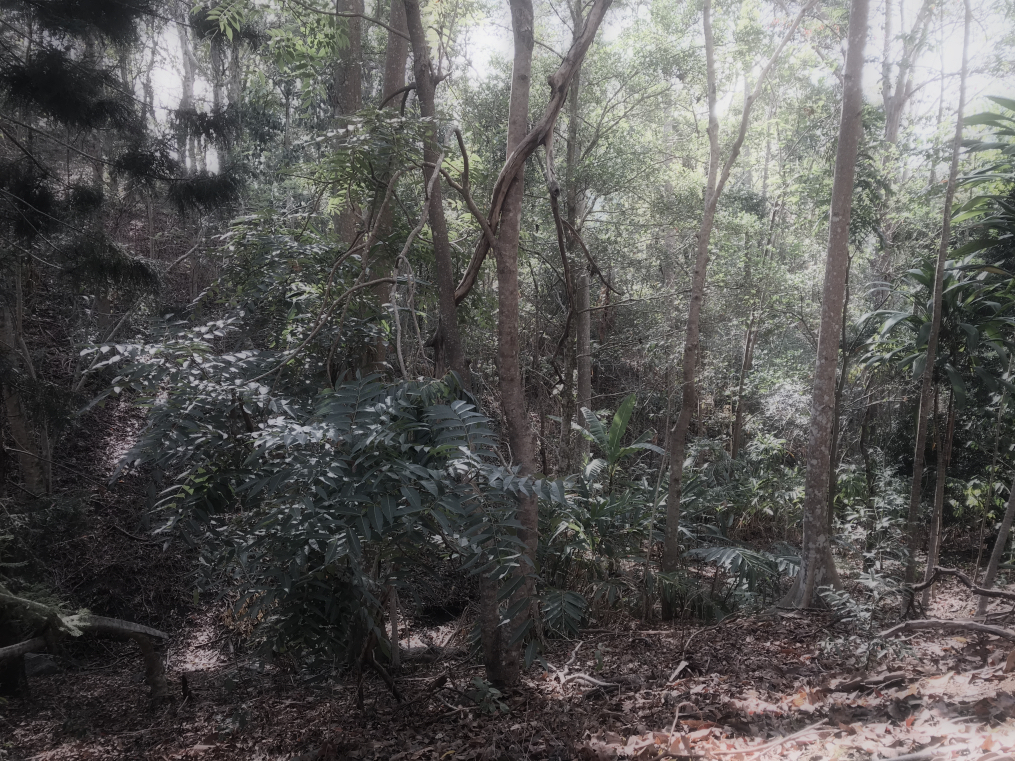
The forest floor is covered in ankle-high layers of dead, brown leaves. It could easily be mistaken for an Autumn scene somewhere in Europe. Yet this is a rainforest in sub-tropical Australia, a country where the trees are always green and shed their bark, not their leaves.
There still is some green around, as the hardier plants and trees stubbornly hold on to the preciously little water they can still access. There are patches of colour even, from flowering trees and shrubs that feel they are dying and push out a last abundance of flowers in a last attempt to produce enough seeds to preserve the species for after the drought.
But most of the trees are bare. The once dense jungle is visibly thinning out. It is like the forest is slowly fading away and becoming transparent, like a ghost of its former impenetrable self. Where walls of green once blocked all views, dark outlines of trees in charcoal black and burnt-earth browns are no more than shadows between here and the now starkly visible horizon.
Is this what the death of an eco-system looks like? Is this how life fades away, one species at a time, until only the translucent outlines of that abundance remain? Will we all become pale, lifeless, shimmering ghosts, aimlessly wandering through a desert of dead and dying dreams, vainly grasping at the mirages of the lush and vibrant riches we failed to value when it was all still alive around us?





 The Dragon and The Phoenix