
A while back I shared that I felt my Country was reclaiming me. One part of that process was reconnecting with Nature. Feeling in touch with and being welcomed by my re-discovered natural environment gave me a feeling of coming home I hadn’t expect to find.
But there is more to this process. There are the stories hidden in the land I am reconnecting to.
For decades I lived in Australia. One of the comments my European relatives and friends frequently made when visiting was that Australia has great natural beauty, but is lacking in history. They see it as a young country, lacking in monumental buildings, historic towns and the occasional ruins of past civilisations. On the surface they are not completely wrong. Compared to other continents, the evidence of long-term human occupation of the land is far less visible. The actual human history of Australia, however, runs much deeper than most of the monuments and archeological sites visited by tourists elsewhere in the world.
How deep that history goes only becomes apparent when one discovers the oral history, art, music and dances performed by Australia’s indigenous people. They tell stories that are 10s of thousands of years old. Their art contains knowledge and insights that has been passed on for hundreds of generations. And, interestingly, instead of being connected to man-made monuments, most of those ancient stories, songs and artworks are intimately connected with the land itself. Every natural feature has its story, it seems, and is, through that story, connected to many other places in the continent. To an indigenous Australian, walking through Country is never just a walk from place A to B; it is simultaneously a walk through the history of their people, a revisiting of landmarks they see as their ancestors, and a re-activation of all the knowledge and learning of the generations that went before. Every step they take is securely anchoring them to Country, telling them in no uncertain terms that this is where they belong.
I came back to The Netherlands thinking I would find plenty of visible history but little of the non-tangible story kind. As it turns out, I was wrong.
Sure, the visible stuff is easier to find. It is in all the travel guides, after all. But the land here is full of stories, too, if you know where to look for them. They are just buried much deeper than in Australia, where there are still people actively keeping them alive.
There is a little lake near our house. It is man-made. Not because people wanted to have a lake, but because they were digging out the peat they needed for fuel to warm their houses. The landscape is dotted with small lakes and waterways, speaking of people burning the soil because there weren’t trees enough around to harvest for firewood.
Some of the lakes are almost perfectly circular, which gives them an even more artificial appearance. But those lakes, called pingos, are actually a natural phenomena, caused by ice and meltwater during the ice ages that covered all of the land here. Put together, the land speaks of the slow forces of erosion and the much faster forces of surface mining, both creating and recreating a very unique landscape.
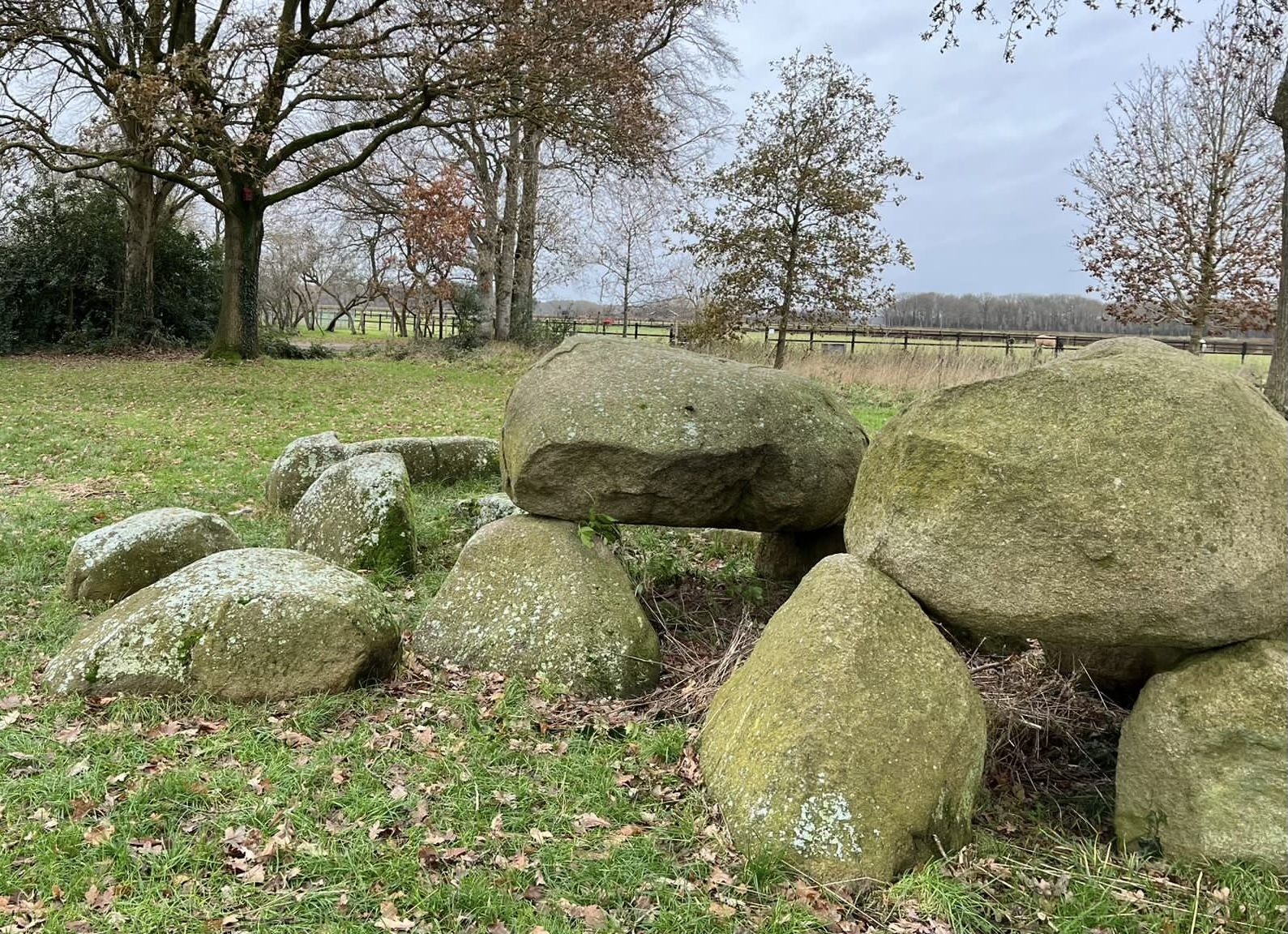
There are some ancient monuments here, too, from the time people here were hunter-gatherers. Huge boulders are grouped together and capped with even bigger ones to form hill-graves we call “Hunebedden” (dolmen), literally meaning “beds of giants”. Built long before the later farmers of this land arrived from the East, they were incorporated into local legends about the giants that roamed the land in ancient days. Some of those legends became fairy tales, others got incorporated into local lore, and some made it into religious tales of saints and demons battling it out amongst the giant stones.
It is till possible, with some research and a lot of patience, to piece together a tapestry of half-forgotten, half-misremembered storylines that were once the way our ancestors here gave meaning to the landscape around them. Doing so, I find, is another way in which this Country is reclaiming me and weaving me into its very being. The more I stumble across the ancient stories, the easier it becomes for me to not feel strange, separate and alienated but part of everything around me. The more I retell and reconstruct those old narratives while exploring the land, the more I feel I am becoming a participant and caretaker, not just a curious tourist passing through.

 The Dragon and The Phoenix